SciArt Initiative

  • Mission
  • Program Archive
    • Events
    • Exhibits
    • Residency
    • Colloquium
    • Magazine
  • Mission
  • Program Archive
    • Events
    • Exhibits
    • Residency
    • Colloquium
    • Magazine

Geetha & Ben

Week 15: Geetha & Ben

1/7/2020

0 Comments

 
Geetha

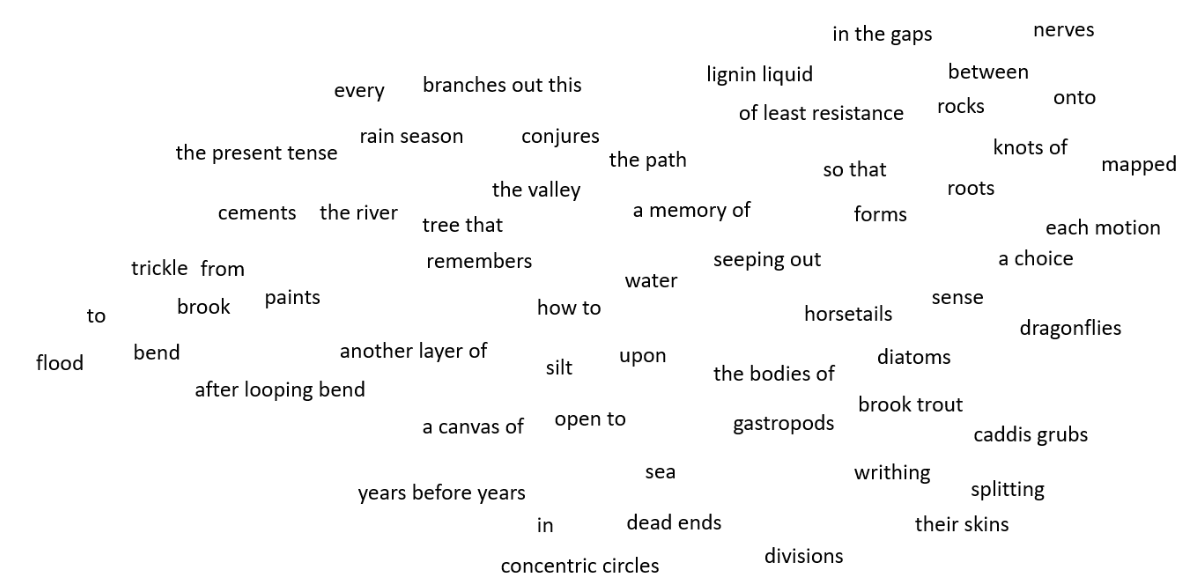
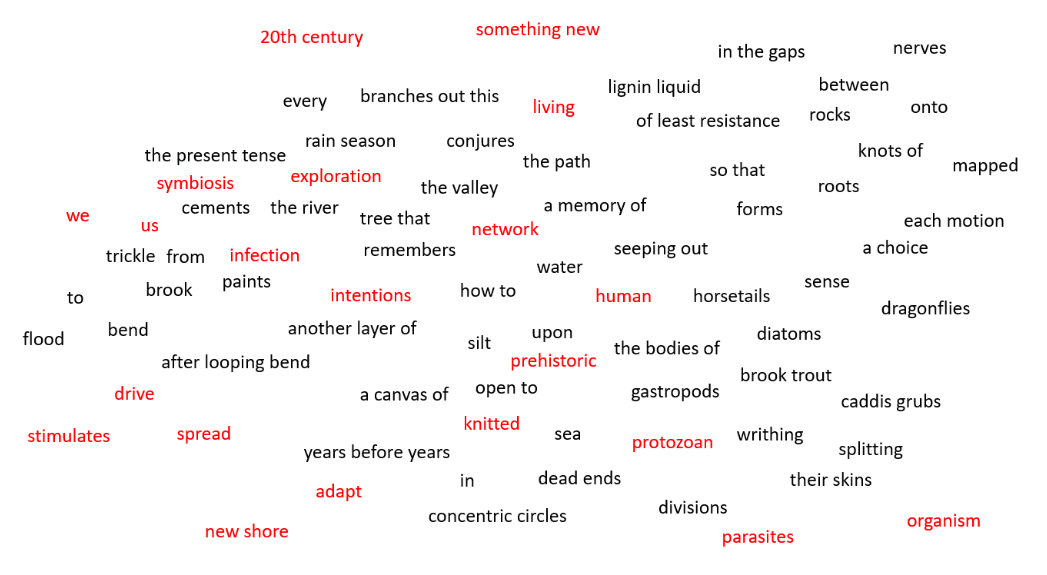
Over the holiday season I tried turning some prose poetry into concrete poetry (essentially converting a block of text into a graphic). I had discussed with Ben an idea for using sentences to mimic neural circuit networks and wrote a poem that began by thinking of a dry river bed as the “memory” of a river that fills in each rain season. From that text, I created the following word cloud:
Picture
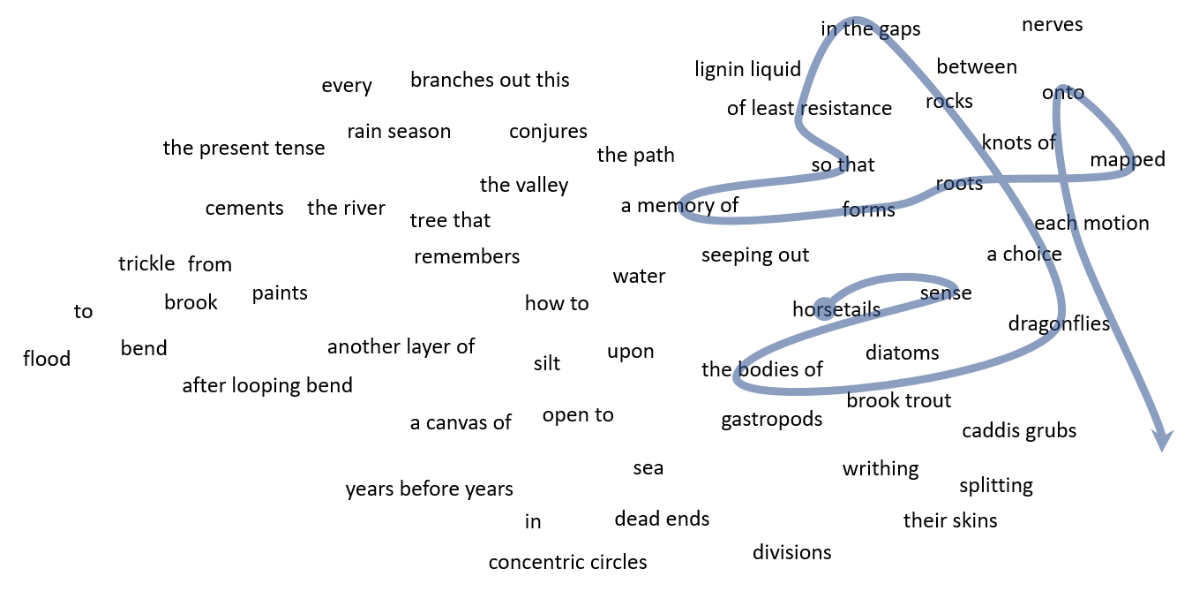
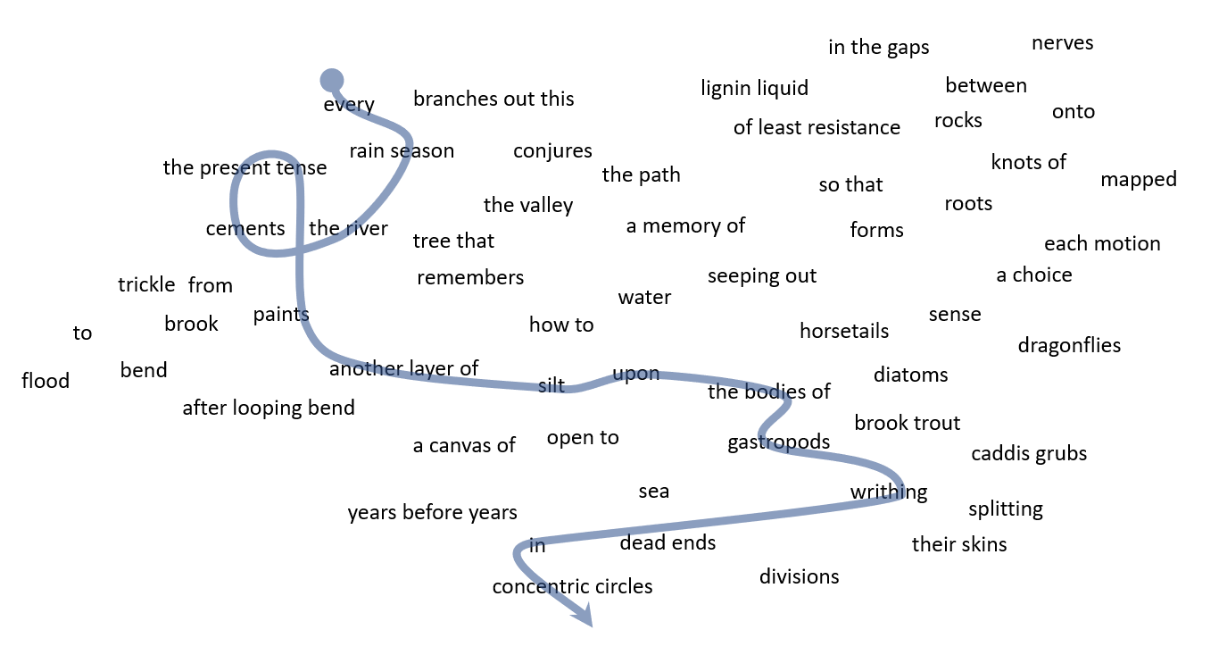
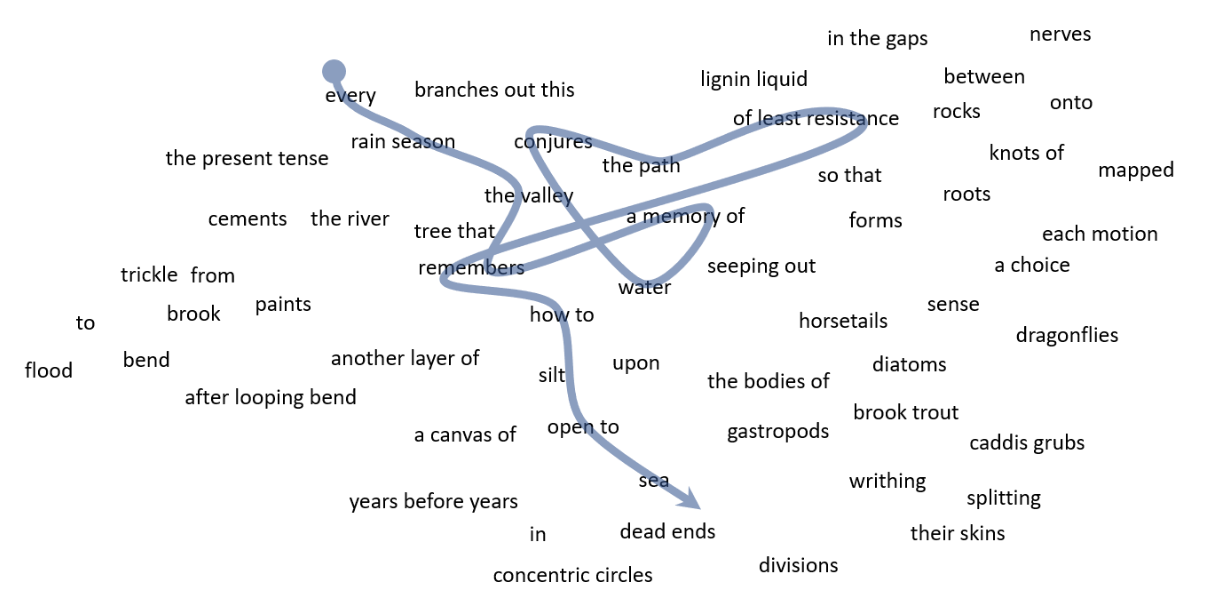
The idea behind this cloud was to fragment sentences such that you could read them freeform, following any path you choose. Three examples follow:
Picture
Picture
Picture
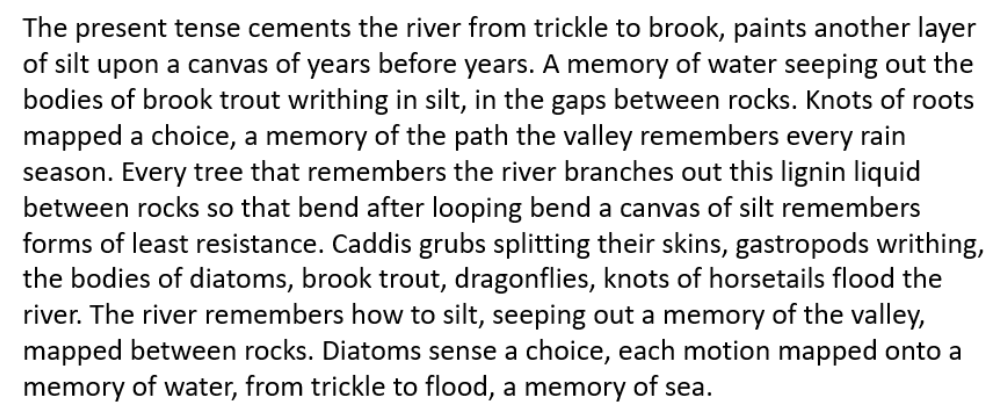
Ultimately, this kind of structure allowed me to create new associations between the words and phrases. An example of a prose poem constructed from the above cloud follows:​
Picture
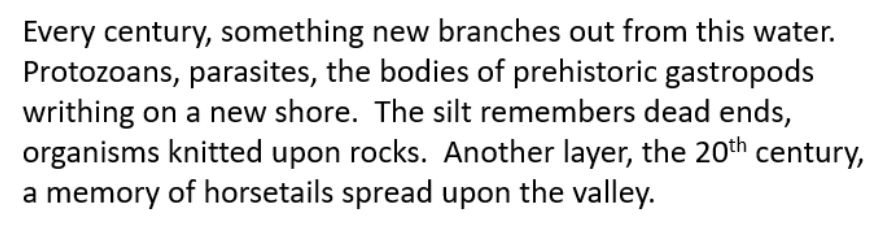
I sent Ben this experiment and asked him to a) construct poems out of the original word cloud, and b) add to the cloud and extract something from the updated version. Here are his additions, and a prose poem he constructed from it: 
Picture
Picture
We’re both pretty excited about the results of this process, and our new project is to apply the method to the songbirds we discussed at the very beginning of our residency. Ben told me about the pioneering, decades-spanning work of neuroscientist Fernando Nottebohm on how canaries learn their songs. We’re now going to use some of Nottebohm’s seminal research papers to seed a new word cloud out of which we’ll generate new texts. 

One of the reasons why I’m excited about this kind of writing is because it echoes in form, if not in meaning, the way brains work in building associations out of disparate experiences. Beyond that, it is also jostling me to write unexpectedly, because I’ve confined myself to a limited set of words, and need to find something to say out of those limitations. The results are surprising and satisfying. 

Meanwhile, reading about canaries has led me to a new appreciation of not just how their brains work, but how hard researchers work to understand them. All I previously knew of canaries was that they were carried into mines to forewarn of carbon monoxide or methane exposure. If the bird stopped singing, you knew you were in imminent danger. In the first of the Nottebohm papers that Ben shared with me, I learned that the process of understanding how canaries learn their songs involves surgically damaging the parts of their brains that produce those songs, then waiting for them to recover to document how their singing changed. Some birds sang ineffectually or simplistically, others not at all, depending on the location and extent of damage done to their brains. I’m dwelling on the image of countless mute canaries, signaling by their silence not danger, but the locus of their song-making abilities. ​

Ben

Happy New Year! Although the calendar has just begun, the clock is winding down on Geetha and my SciArt collaboration. With this deadline in mind, we have been discussing the various different algorithms that we have created to generate text in a manner inspired by the vocal learning circuit in songbirds. We’ve recently focused one that has yielded some interesting results. Each approach that we have developed uses a different mechanism to promote novelty and growth by the introduction of random changes. The difficulty, we have observed, is finding the right balance between memory (the signal) and the noise. Too little noise and the text is stagnant, without change. Too much noise and the text quickly becomes meaningless. Our new method has just the right “noise” level, allowing for the generation of readable prose poems. Our process begins with the generation of a word landscape, in which the words taken from selected sentences of a seed text are placed at random locations on a blank sheet. The author then chooses a path through the words in the landscape to form sentences. The prose poem is limited to the words on the landscape, but the author has the ability to make small changes. For example, “a” may become “the”, “parasite” may become “parasites,” “ran” may become “run,” etc. After the author constructs her prose poem, she passes on the landscape to the next author. The new author adds additional words to the landscape, then chooses paths through the landscape constructing his prose poem. For the seed text, we have chosen five research articles by the author Fernando Nottebohm, an Argentinian neuroscientist and Professor at the Rockefeller University in New York City. The articles we have selected represent several of the key experiments that inform our understanding the neural circuits that control singing in songbirds and how these circuits change with development and learning. 
0 Comments


Leave a Reply.

    Picture
    Picture
Powered by Create your own unique website with customizable templates.