SciArt Initiative

  • Mission
  • Program Archive
    • Events
    • Exhibits
    • Residency
    • Colloquium
    • Magazine
  • Mission
  • Program Archive
    • Events
    • Exhibits
    • Residency
    • Colloquium
    • Magazine

​Shanthi & Leilhae

Blog 6: Shanthi & Leilhae

12/7/2020

0 Comments

 
Shanthi

Kolams have been on my mind lately as I have been conducting workshops and presenting them online, and drawing one in my book every morning. I am currently working on a project that involves scaling them up, understanding the shapes and creating templates. So, I decided to dedicate this blog post to Kolams.
Picture
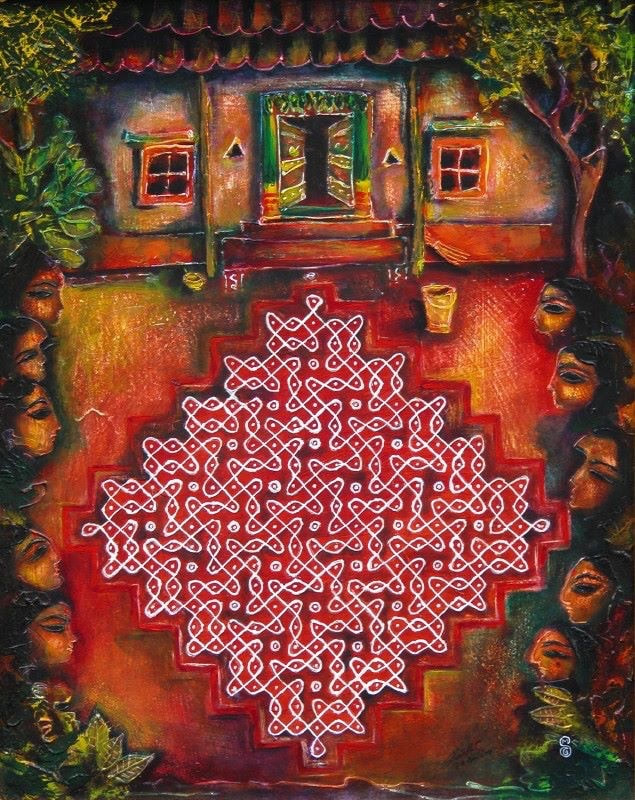
Kolam-Celebrations, Acrylic on Masonite, 20”x16”, 2001
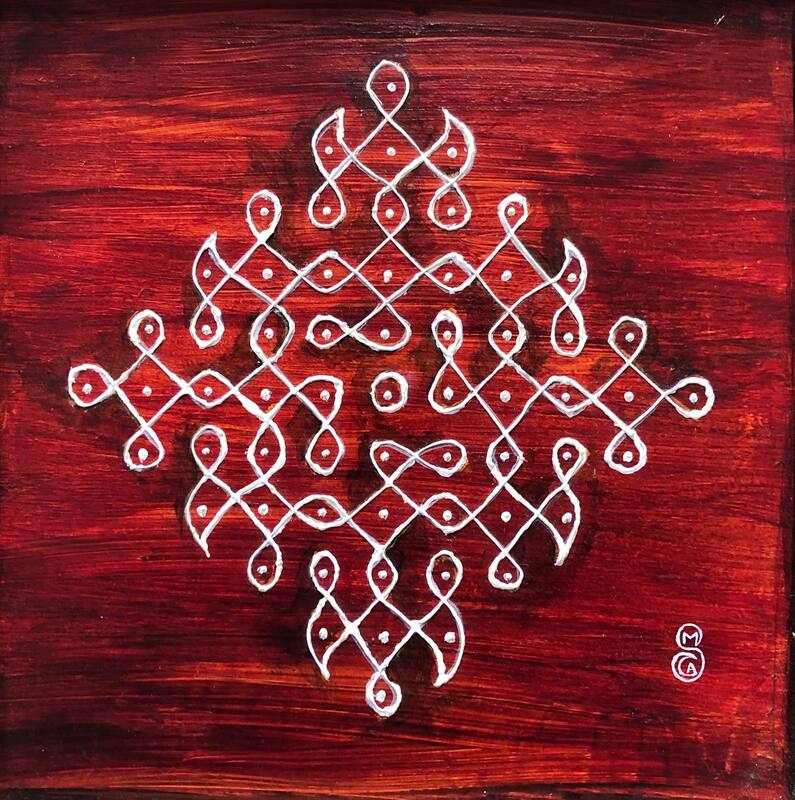
Kolam is a traditional art from Tamil Nadu, India that is drawn on the floor in front of houses using powdered rice or rock at sunrise and sunset everyday. The powder is pinched out with the thumb and index finger to create a grid of dots and then the lines that go around the dots or connect them, are drawn. As these patterns are made on the floors, they are walked over and eventually get erased in a few hours, reminding us about impermanence and non-attachment and making way for a new beginning.​
Picture
Picture
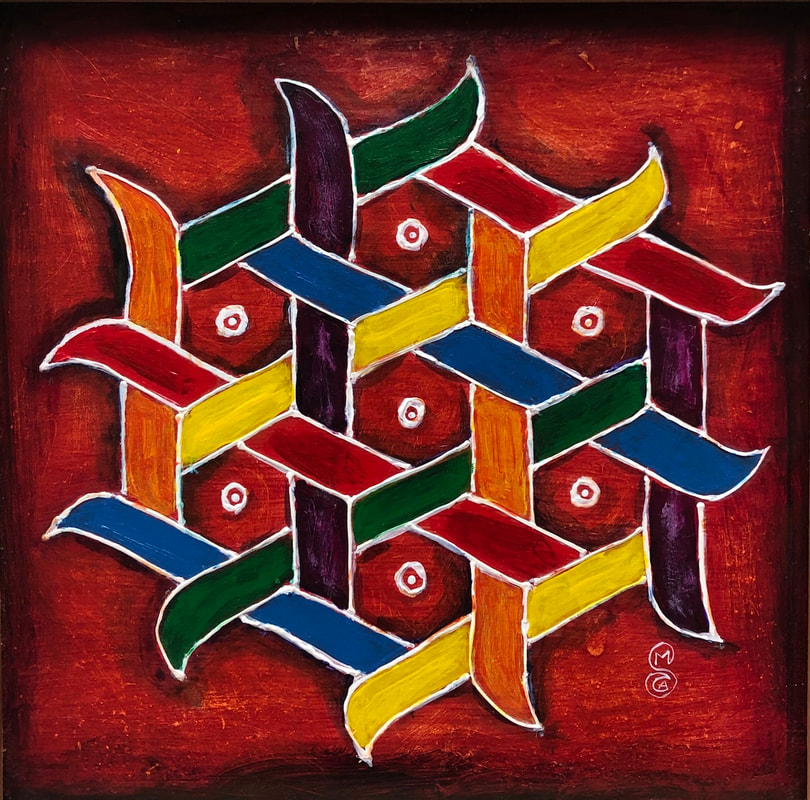
Kolam-Maroon1 & 2, Acrylic on Masonite, 2001
I learned to draw kolams as a child from my mother and grandmother by watching them draw the patterns and explain its philosophy along with their own take on it. I sometimes wonder if it was this early exposure to connecting ideas and images that eventually paved way for my interest in abstract concepts, be it in art or science. I have always been drawn to patterns, symmetries and connections, incorporating them into my artwork. I also remember being excited about courses in astronomy, relativity and quantum mechanics more than other topics that involved the immediate physical world we live in. I enjoyed studying the various theories and the math behind them and was curious to learn more about what was not directly perceivable. 

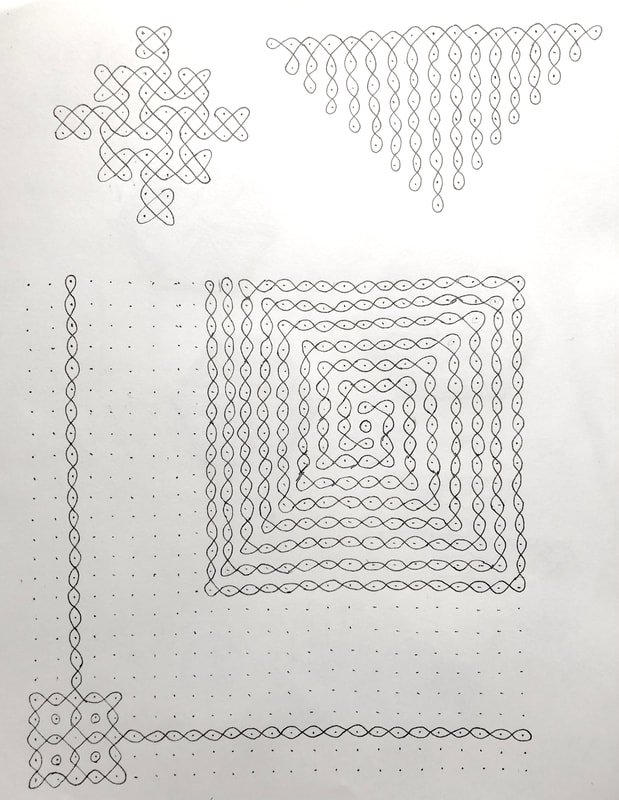
The women who draw kolams every morning in India carry on an old tradition without getting into the intricacies on the math involved in it or its artistic aesthetics. I am often reminded of cosmology when I work with kolams as they symbolize the cyclic nature of creation and destruction, or the particle and wave nature of light. The undulating lines are like the curved paths of light waves around massive objects. The image of LIGO with its stretched out arms inspired me to draw a kolam as the path travelled by the LASER in the interferometer is split into two perpendicular directions and is reflected back.
Picture
Kolam- Cosmology_LIGO, Pencil on Paper, 2020
The dots in a kolam are said to represent challenges or obstacles and if we can weave our way through it all like the lines, and get back to the starting point, while maintaining a symmetry, we will be able to deal with life’s problems. As I listen to the many lectures and interviews on the stories behind the discovery of the gravitational waves, the many hurdles and challenges that had to be faced, analyzed and resolved are truly remarkable. The perseverance and determination paid off leading to another new way of studying the cosmos. For me, kolams have served as a guide as I explore new directions, and continue to amaze me with their versatility. 

Leilhae

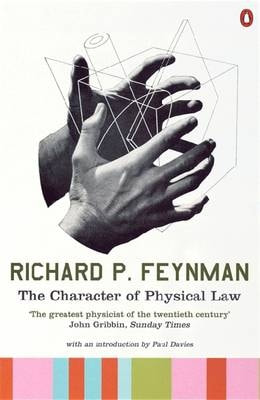
The latest piece I had the time to read was the chapter "Time and Irreversibility" of Richard Feynman's book The Character of Physical Laws. It is actually the retranscription of lectures that Feynman gave at the University of Cornell in the 60's, where he describes the common properties of the laws of physics, until this chapter transitioning to the physical features that are not actually laws. Time is one of them, as time is currently not understood to be a fundamental force of Nature (those ones are, actually, symmetric in time, in the way that they can be reversed in time to go from consequences to cause in a logical manner), but rather a consequence of the dynamical process that take place. Despite this emergent explanation, time is an intriguing concept that still keeps physicists and philosophers intrigued. I would myself love to devote more of my time to study time, but it turned out that the end of year has been the busiest period of an already intense year. Gravitational-waves are being detected that require careful examination, new positions are open that are opportunities to develop exciting research, and once again in my semi-nomadic academic lifestyle I find myself surrounded by carton boxes.  

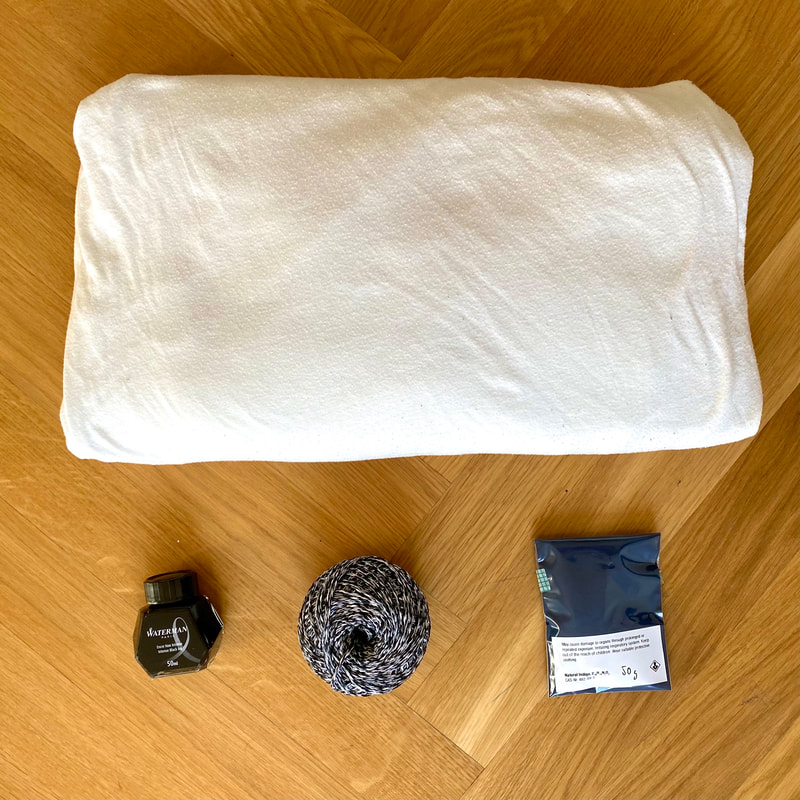
I still hoped to dye some fabric as tests for our artistic project with Shanthi. I kept separate in a bag, an old white sheet, some indigo powder, ink and rope (and as I write this, I realize it can also be the material for a sailor, as if I was waiting to go riding on spacetime). I got them ready in case I could find some instants to make the dye, which did not occur yet. I did have precious advice from Shanthi, when I learnt the difficult process of using indigo dye. "You can start with ink", she told me. "Start small with the material at home, do a first test, then add one feature at the time, complexify your process little by little." Her wisdom and her freedom showed me how much I have to reach them, the exact tool, the complicated procedure, are not in my favor if they are so unreachable that they don't give me the time to dedicate to our project. Comforted by her words, I will keep the material with me over the holidays, wishing to create some pieces that may match her beautiful embroidery. And I will remind the borderless creativity that she let me perceive in our regular conversations. "What would happen if time was traveling in waves?", did she ask me the last time. A thought I never had, but that threw me in a fascinating mental experiment.
Picture
Picture
0 Comments


Leave a Reply.

    Picture
    Shanthi Chandrasekar
    Picture
    Leilhae
Powered by Create your own unique website with customizable templates.